Alcohol
Last published: December 05, 2023
What is alcohol?
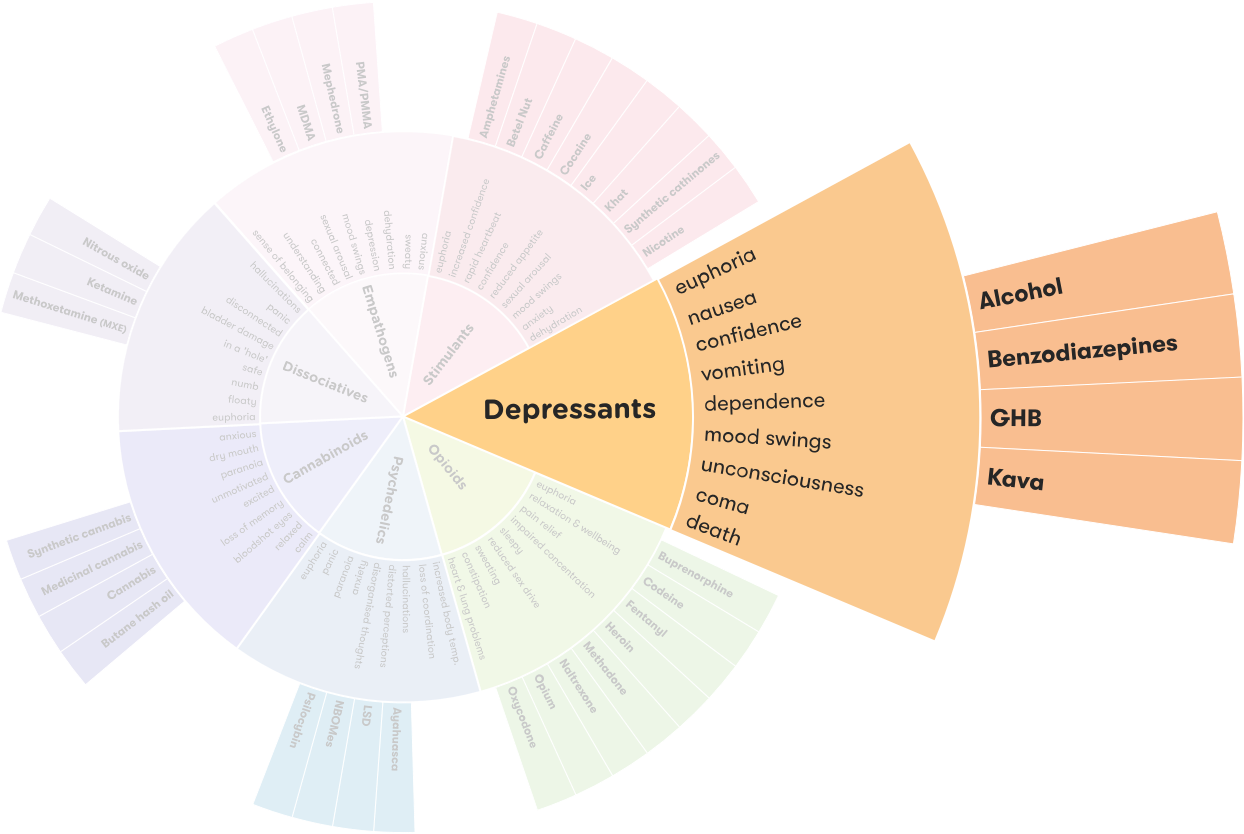
Alcohol is a depressant drug, which means it slows down the messages travelling between the brain and body.1
What does alcohol look like?
Alcohol is a colourless fermented or brewed liquid made from ethanol and flavoured water.2 3
Other names
Booze, grog, piss, liquor, charge, plonk, bevvies, nip
Other types of depressants
How is alcohol used?
Alcohol is typically drunk in the form of beer, wine, cider or spirits. It can affect you quickly depending on the type of drink, as well as a person’s weight, height, health and amount consumed.4,5
Effects of alcohol
There is no safe level of drug use. Use of any drug always carries some risk. It’s important to be careful when taking any type of drug.
The Australian guidelines recommend no more than 10 standard drinks a week and no more than 4 drinks in one day to reduce the risk of harm from alcohol-related disease or injury.6
Alcohol affects everyone differently, based on:
- size, weight and health
- whether the person is used to drinking it
- whether other drugs are taken around the same time
- the amount drunk
- the strength of the drink
You may experience:
- feeling relaxed
- increased confidence and energy
- trouble concentrating
- slower reflexes
- clumsiness
- slurred speech
- feeling happier or sadder, depending on your mood1, 4, 5, 7
National alcohol guidelines
Based on the latest scientific evidence, new alcohol guidelines have been released to help reduce the risk of alcohol harm and improve the health of Australians.
Impact of mood and environment
Drugs that affect a person’s mental state (psychoactive drugs) can also have varied effects depending on a person’s mood (often called the ‘set’) or the environment they are in (the ‘setting’):
- Set: a person’s state of mind, previous encounters with alcohol, and expectations of what’s going to happen. For example, feelings of stress or anxiety before drinking may result in an unpleasant experience and worsening of those feelings.8
- Setting: the environment in which someone consumes alcohol. For example, heavy drinking tends to occur more when we’re with friends and at social events, and we can make more risky decisions in these environments due to lowered inhibitions.8
Overdose
If you drink a large amount, you could overdose.
Call an ambulance straight away by dialling triple zero (000) if you or someone else has any of the following symptoms:
- slowed breathing
- confusion
- blurred vision
- nausea, vomiting
- passing out
- coma.1, 6
Ambulance officers do not need to involve the police.
Coming down
The following day after drinking alcohol, you may have a hangover. Effects include:
- headache
- nausea
- tiredness and trembling
- increased heart rate and blood pressure
- dry mouth
- trouble concentrating
- anxiety
- poor or decreased sleep.6, 9
Sobering up takes time – the liver gets rid of about one standard drink per hour.4 Sweating it out with exercise, cold showers, coffee, fresh air, or vomiting won’t speed up the process. This may ease the symptoms, but it won’t remove alcohol from the bloodstream any faster. This means it may not be safe to drive or work the following day.10, 11
Long-term effects
Regular and heavy use of alcohol can cause:
- worsening of mental health conditions
- poor memory and brain damage
- difficulty getting an erection
- difficulty having children
- liver disease
- cancer
- high blood pressure and heart disease
- needing to drink more to get the same effect
- physical dependence on alcohol4-6
Alcohol and mental health
Research shows a relationship between people who are dependent on alcohol and increased mental health issues. People with mental health issues may also drink more alcohol to self-medicate. Although alcohol might feel like it relieves symptoms of anxiety or depression in the short term, it is more likely to lead to longer-term anxiety and depression.12,13
Tolerance and dependence
People who regularly use alcohol can become dependent on the drug. They may feel they need alcohol to go about their normal activities like working, studying and socialising, or just to get through the day.
They may also develop a tolerance to it, which means they need to drink larger amounts of alcohol to get the same effect. People who develop a tolerance and dependence on alcohol experience more alcohol-related harms.3,14
Mixing alcohol with other drugs
Mixing alcohol with other drugs can have unpredictable effects and increase the risk of harm
- Alcohol and cannabis: can cause nausea, impaired coordination, vomiting.
- Alcohol and cocaine/ice/speed can feel less intoxicated due to the stimulant effect of methamphetamine/cocaine and lead to drinking more. Increases risk of alcohol poisoning.
- Alcohol and benzodiazepines/GHB/heroin: high risk of overdose, may feel clumsy or uncoordinated, shallow breathing, nausea and vomiting, memory loss, passing out, and possible death.15
More on Polydrug use
‘Polydrug use’ is a term for the use of more than one drug or type of drug at the same time or one after another. Polydrug use can involve both illicit drugs and legal substances, such as alcohol and medications.
Reducing harm
There are ways you can reduce the risk of harm when drinking alcohol:
- Follow the Australian drinking guidelines – no more than 10 standard drinks in a week and no more than 4 standard drinks at any one time
- Drink water or other non-alcoholic beverages between alcoholic drinks.
- Avoid drinking in rounds with friends, as you may end up drinking more than planned.
- Order smaller serves of beer, cider and spirits, rather than pints or double serves.
- Don’t let others top up your glass if you’re sharing a bottle of wine as you may lose track of how many drinks you’ve had.
- Avoid high-alcohol content beverages, such as cocktails or spirits.
- Set the number of drinks you’ll have, and count them to help you stick to it
- Eat some food before and while drinking, to slow your drinking pace and slow the absorption of alcohol.
- Occupy yourself while drinking to reduce the amount you’re consuming; play pool, sing karaoke, dance, talk to friends.6,15
Withdrawal
Giving up alcohol after a long time is challenging because the body has to get used to functioning without it. Please seek advice from a health professional as alcohol withdrawal can be serious and sometimes cause death.16
Withdrawal symptoms can start within a few hours after the last drinks and can last for two to seven days. Symptoms include:
- sweating
- tremors
- nausea
- anxiety, irritability, difficultly sleeping
- seizure of fits
- poor appetite
- delusions and hallucinations
- death.1,6.16,28
Getting help
If your use of alcohol is affecting your health, family, relationships, work, school, financial or other life situations, or you’re concerned about a loved one, you can find help and support.
Call the National Alcohol and Other Drug Hotline on 1800 250 015 for free and confidential advice, information and counselling about alcohol and other drugs
Help and Support Services search
Find a service in your local area from our list. Simply add your location or postcode and filter by service type to quickly discover help near you.
If you're looking for other information or support options, send us an email at druginfo@adf.org.au
Path2Help
Not sure what you are looking for? Try our intuitive Path2Help tool and be matched with support information and services tailored to you.
Find out more
There are laws that govern how alcohol may be used. These laws may differ depending on the state, territory, or local area. For example, in some areas, local by-laws make it illegal to drink alcohol in public places such as beaches, parks and streets.17
It’s an offence for a person who is under 18 years of age to buy, receive or drink alcohol on licensed premises, unless they are with a parent or guardian.17
In some states in Australia, it’s also an offence to supply a person under 18 years of age with alcohol in a private home, unless the young person’s parent or guardian has given permission and the alcohol is supplied in a responsible manner. This is known as secondary supply.17
It is illegal to drive under the influence of alcohol.17
Penalties for breaking these laws can include fines, imprisonment, and disqualification from driving.17
Employers have legal obligations in relation to health and safety of their workers and people who visit their workplace.11
National
- Around 1 in 5 (16.8%) Australians aged 14 years or older drink at levels that put them at risk of alcohol-related harm over their lifetime.
- Around 1 in 10 or 9.9% of people who drink are dependent on alcohol.
- 52% of Australians took action to reduce their drinking.18
- The estimated social cost of alcohol use in Australia was $66.8 billion in 2017–2018.19
- In 2021 there were 1,559 alcohol related deaths in Australia.20
Young people
- Young Australians (aged 14–24) have their first full serve of alcohol at 16.2 years on average.
- Young adults aged 18–24 were the most likely of all age groups to exceed single occasion risk guidelines at least monthly (41%)
- From 2007 to 2019, the proportion of people aged 14–17 who abstained increased from 39% to 73%, while for people aged 18–24 it rose from 13.1% to 21%. 18
- Brands B, Sproule B, Marshman J. Drugs and Drug Abuse. Toronto: Addiction Research Foundation; 1998 [22.02.2023].
- Healey J. Alcohol and binge drinking. Thirroul, N.S.W.: Spinney Press; 2011 [cited 2021 April].
- Connolly S. Alcohol. Oxford: Heinemann Library; 2000 [15.11.2023].
- Department of Health and Aged Care. What are the effects of alcohol? 2022 [24.05.2023].
- Australian Government Department of Health. What are the effects of alcohol? 2020 [cited 2021 April].
- NHMRC.Australian guidelines to reduce health risks from drinking alcohol Canberra: National Health and Medical Research Council; 2020 [08.02.2023].
- Brands B, Sproule B, Marshman J, Ontario. Addiction Research F. Drugs & drug abuse : a reference text. Toronto, Ont.: Addiction Research Foundation; 1998 [cited 2021 May].
- Nutt D. Drugs without the hot air : making sense of legal and illegal drugs. Cambridge: UIT Cambridge Ltd; 2012 [10.10.2023].
- Health Direct. How alcohol affects your health 2022 [06.09.2023].
- VicRoads. Alcohol and road safety Victoria, Australia: VicRoads; 2020 [cited 2021 April].
- Victorian Trades Hall Council's (VTHC) Occupational Health and Safety Unit. Alcohol and work Melbourne, Australia: Victorian Trades Hall Council's (VTHC) Occupational Health and Safety Unit; 2020 [11.09.2023].
- Jacob L, Smith L, Armstrong NC, Yakkundi A, Barnett Y, Butler L, et al. Alcohol use and mental health during COVID-19 lockdown: A cross-sectional study in a sample of UK adults. Drug and alcohol dependence [Internet]. 2021 [cited 2021 May]; 219:[108488 p.].
- Puddephatt J-A, Jones A, Gage SH, Fear NT, Field M, McManus S, et al. Associations of alcohol use, mental health and socioeconomic status in England: Findings from a representative population survey. Drug and Alcohol Dependence [Internet]. 2021 [cited 2021 May]; 219.
- Haeny AM, Weaver CC, Martinez JA, Steinley D, Sher KJDoPCUUS. Is the deliberate self-induction of alcohol tolerance associated with negative alcohol outcomes?Addictive Behaviors [Internet]. 2017 [cited 2021 May]; 65:[98-101 pp.].
- Hi-Ground. Alcohol [24.05.2023].
- Manning V, Arunogiri S, Frei M, Ridley K, Mroz K, Campbell S et al. Alcohol and other Drug Withdrawal: Practice Guidelines. Richmond: Turning Point; 2018 [01.02.2023].
- Australian Government Department of Health. Alcohol laws in Australia 2022 [11.09.2023].
- Australian Institute of Health and Welfare. National drug strategy household survey 2019-2020 [cited 2021 May].
- Whetton S, Tait R, Gilmore W, Dey T, Agramunt S, Abdul Halim S, et al. Examining the Social and Economic Costs of Alcohol Use in Australia: 2017/18. National Drug Research Institute: Curtin University; 2021 [11.09.2023].
- Australian Bureau of Statistics. Causes of death, Australia: ABS; 2022 [11.08.2023].
Related content
Explore depressants on the Drug Wheel